THE MIXED CHOIR
There are no records to be found to show that there
was an organized mixed choir while still in the old church building. In all
probability it was just group singing with either Amanda or Emma Froehner at
the organ.
The first record of a mixed choir in the new church
at the present location was in 1915 called the Singing Society.
Charter members were as follows:
R.H. Henkel
|
Gus Gandre |
|
Edwin Froehner |
Elmer Tolle |
|
Walter Afflerbach |
Ella Tieken |
|
|
|
|
Hilda Gandre |
Augusta Afflerbach |
|
Margaret Deschner |
Ida Tieken |
|
Kate Deschner |
Emma Philippus |
|
|
|
|
Erna Raeke |
Pearl Kleinknecht |
|
Arthur Raeke |
Pauline Philippus |
|
Willie Philippus |
Herman Philippus |
|
|
Walter Hornung |
|
Hulda Hornung |
|
These Charter members took their organization very
seriously according to the constitution. A committee was appointed to present a
list of rules, in German, to be voted upon. Those appointed were Erna Raeke, Augusta Afflerbach
and
The name shall be: Choir of the
Article 1. The object of the same shall be to
give the young people of our congregation a better opportunity to develop the
gift of singing as well as their spiritual welfare and the up bringing of the
congregation through songs in public places.
Article 2. The officers shall be as follows: One
director, an assistant director, a secretary and a treasurer. These shall form
the cabinet.
Article 3. The officers shall perform the
following duties: a. The director shall open meetings
with song and prayer and take charge of the song practice. b.
In case of absence of the director, the assistant director shall take his
place. c. The secretary to keep minutes of the business meetings and call roll
at ordinary practices. d. The treasurer to take charge of all funds and keep a
true record of same. The funds shall be used in purchasing books and material,
which shall remain the property of the choir.
Article 4. Entitled to membership are all
belonging to a Christian Church: a. Privilege, the right to vote and take part
in open singing. b. Obligations, to pay an entrance
fee of 25¢ and 25¢ annually and to abide by the rules and
regulations of the organization. c.
Article 5. All officers shall be elected annually through ballot
with majority ruling. A business meeting shall be held semi-annually.
Article 6. At all the business meetings the
majority of the members present shall rule.
Article 7. A quorum consists of twelve members at
all business meetings.
Article 8. This constitution can be changed only
through a two-thirds majority of all members present.
The first officers were: Director. R.H.
Henkel; assistant director, Erna
Raeke; secretary,
On
There were several more committees appointed. One of
these had the duty to place the singers in their most suited voice range. Those
serving on this committee were: Edwin Froehner, Hilda Raeke,
Margaret Deschner, Margaret Siepmann and Walter Raeke. Another committee: R.H. Henkel,
Erna Froehner, Hilda Raeke,
Nettie Lindemann and Elmer Tolle
were to select new song books.
In 1918 it was decided to use the English language
instead of the German. R.H. Henkel continued to
direct through 1919 after which Erna Froehner
directed with Bertha Tolle the assistant. Practices
usually lasted one and a half hours with average attendance of twenty to
twenty-three singers.
Final record of minutes available
were January 1923 at which time it was decided to disband.
During the 1930's Benno
Froehner sometimes directed and Margaret Siepmann was
the organist and also helped as assistant director, to work up specials. During
the 1940's the mixed choir performed only to sing cantatas for Christmas or
Easter time with Benno Froehner directing and Estelle
Froehner accompanying on the piano.
Lorene Froehner, Mary Ellen Fink and Gilbert Philippus each had a hand in bringing young mixed voices
together for specials.
In the late 1960's
|
|
Bernice Lindemann |
Estelle Froehner, Pianist |
Laura Walker |
Gladys Lindemann |
Allan Fink |
Mary Lou Philippus
|
|
|
Lu Ann Fullilove |
Leonard Gandre |
|
Carolyn Orts |
Noel Lindemann |
|
Marie Schauer |
Cara McGill |
|
Evelyn Mudd |
Gilbert Philippus |
|
Ruby Ruth Gandre |
Dorothy Taylor |
Although
the Mixed Choir was relatively inactive for a period of thirty-seven years, the
music rendered by the choir, has been enjoyed and appreciated on many
occasions, and is a major influence in the organization of the church.
THE MIXED CHOIR
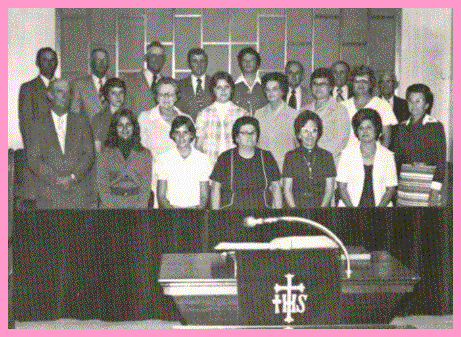
CHOIR 1975
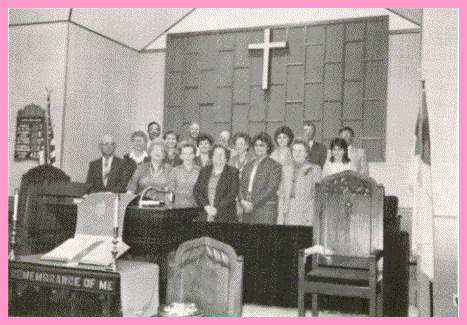
CHOIR 1986
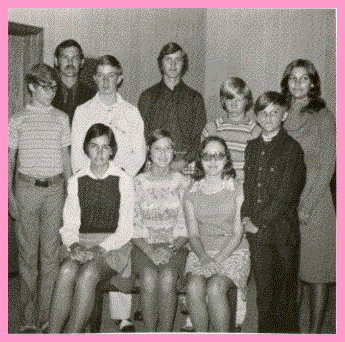
YOUTH CHOIR 1975