MUSIC
IN THE CHURCH
Music
has always been a very important word in the minds and hearts of the people in
the
Voices
of the people were not all that was heard. In the very earliest days of the
life of the church, the old pump organ was used both in the homes and in
religious services to accompany the singing. There were no radios or
televisions, so the family gathered around the organ after the day's work was
completed and sang songs. In some of the older records of the church, mention
was made that the first musical instrument, a pump organ, was purchased
sometime during the 1890's and that Hulda Muenzler (later Mrs. R.H. Henkel)
was the first organist.
Later
in the records of the church, the story is told that the "Jugend Bund" (Epworth League), with the help from
people interested in the music of the church bought a Williams Concert Piano
costing $382.50 in 1924. Both the piano and pump organ were used to accompany
the songs at that time.
In
1947, the pump organ was replaced by the melodious sounds of a Wicks Pipe
Organ. This report is taken from a
On Tuesday
evening of last week the pastor held a Church Conference for the purpose of
hearing the report of the Organ Committee appointed by the Second Quarterly
Conference. As evidenced by the report given by the committee, a thorough
investigation of the different types of organs was made. After careful
consideration, the committee recommended a pipe organ of 353 pipes, made by the
Wicks Organ Company that will cost $3,876.00. This includes the organ, the
grill, transportation, and installation.
After
thorough discussion that included questions about the organ, proposed contract,
and changes in the church necessary to install this type of instrument, the
conference voted in favor of accepting the recommendation of the committee.
The
purchase of this type of organ is a big undertaking for our church. However,
the splendid spirit of cooperation and labor of the membership in raising the
fund so far gives evidence that everyone will give his wholehearted support in
raising the remainder of the necessary amount. The trustees have a plan whereby
all members will have an opportunity in sharing in the purchase of this organ.
On
In
the late 40's and 50's, maintenance of the pipe organ was taken care of every
six months, but when this was no longer available, the
organ was serviced as needed. In 1985, a contract was made with the Wicks Organ
Company to service the instrument every six months. To replace this organ with
a similar one at today's prices, the cost would be in excess of $35,000.00.
In
May of 1965, a Sohmer Studio piano was purchased to
replace the Williams piano, which in turn was moved into the parish hall for
future use. In November of 1983, a
All
these musical intruments would have been of little
value in the worship of our Lord, if there had been no one to play beautiful
music on them. The names of people that follow, all played the piano and a
number of them played the piano and organ: Huida Muenzler Henkel, Emma Froehner Muenzler, Amanda Froehner Stulken,
Rudolf Henkel, Erna Raeke Froehner, Walter Raeke,
Selma Hoting Schultz, Bertha Tolle
Deschner, Margaret Siepmann Froehner, Annie Weichmann Hornung, Luella Froehner Gandre,
Estelie Kattner Froehner,
Lorene Froehner Windle, Ruth Philippus
Foerster, Melene Lindemann Dedear, Shirley Froehner Rhoades, Ina Gay Lindemann Orum, Darlene Rossow Lowman, Mary Blanche Philippus,
Gladys Hausler Lindemann, Virginia Muenzler Zieschang, Cynthia Schauer MacAllister, Lois
Rutledge Willmann, Sandra Soefje
Gandre, Patricia Raeke, and
Lu Ann Lindemann Fuliiiove. Many of these musicians
remained in the community and gave of their time and talent to the church and
to the Lord, but some who went elsewhere, are still working in other churches.
Also, some who played the piano in smaller group meetings are not mentioned in
the above list, but they helped out when given the opportunity to do so when
the elected pianists were absent.
At
various times in the last 100 years there have been persons who played musical
instruments other than the organ and piano. They may have played in a group band
or school band or orchestra and at times a number of them would practice
several religious numbers for performance at the church for special programs.
This special talent was always much appreciated and accepted by the audience.
The
piano or organ in the sanctuary was used many times for weddings and funerals,
and as always the music played a prominent part in these special occasions.
One cannot conclude this story of the music of our church without saying
something about all those who have used their talents of good voices in the
Mixed Choir and the Men's Chorus, as well as the many solos, duets, and
quartets that added much to the various programs rendered in the hundred years
of the life of our church. There is no way one could list all the names, but a
vote of appreciation is due that large group.
The
children in the nursery and beginner's Sunday School classes always brought
great joy to audiences at the annual Christmas programs and other special
occasions. Maybe their renditions were not always in tune or sometimes a little
off-key, but who noticed. The look of joy on their faces and their outpouring
of happiness overshadowed all else when they sang.
If
any names have been omitted in this brief resume of the music of the Monthalia
Church, it was done unintentionally, and the talents that people had were used
to the glory of God and for the uplifting of those present to hear the music,
whether by instrument or voice.
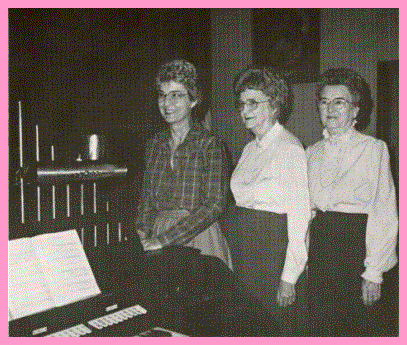
ORGANISTS
Lois Willmann, Luella Gandre, Estelle Froehner